One late night during my years in graduate school, I remember finding myself alone in the math library of Lunt Hall, the mathematics building at Northwestern University. I was pretty tired from studying, so I took a moment to wander around and look at some old books. I opened one at random, which contained an article by the great mathematician Arthur Cayley, and to my frustration I couldn’t even understand the first page of his article. I was surprised, because I had spent a lot of time studying topics building on ideas that Cayley introduced. This experience made me realize that the way he thought about certain concepts was quite alien from the way they are taught today.
When teaching the next generation of mathematicians, the previous generation needs to emphasize what they think are the most important ideas. A great deal of compression takes place, and inevitably, some information is lost in this process. Cayley and his contemporaries knew some things that we have forgotten. Cayley’s paper can still be found in that book in the math library of Lunt Hall1, but no one actually reads it.
1 Actually, it cannot. They moved the old collections off site because no one borrowed those books!
Whatever “knowledge” means, the part that matters to us is not words on a piece of paper, or bits in a hard drive. What matters is the knowledge that is being thought, written, read, and discussed. This knowledge feeds into our communal pool of knowledge, and allows ideas to interact and cross-pollinate in interesting ways.
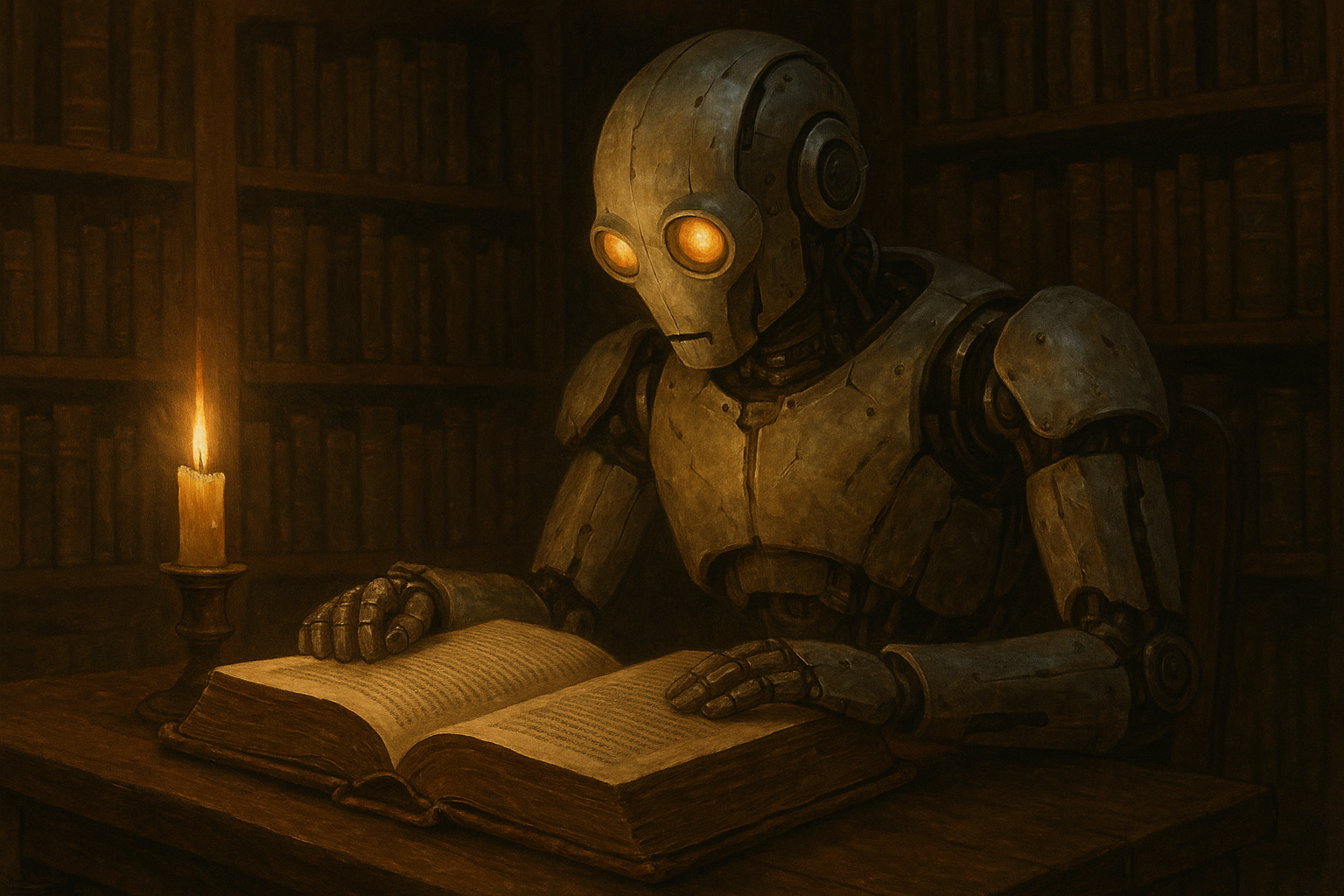
Individual mathematicians live and die, but the community itself persists over time. Key to this continual existence is the fact that older mathematicians teach younger mathematicians, who develop their ideas in conjunction with the wider community. This whole business of knowledge creation and stewardship is a very social process which I doubt we understand very well.
Many aspects of this social process have the potential to transform with AI. What if people interested in math are not taught by older mathematicians, but by chatbots? What if aspiring mathematicians develop their ideas, not in collaboration with older mathematicians, but with AI? And what if the rate of idea generation becomes too high for anyone to keep up with, leading to fewer conversations and more fragmented branches of knowledge? All of these effects weaken the social bonds which are the foundation of our scientific communities.
AI has the potential to completely fragment the state of scientific knowledge, which is already pretty fragmented. Today, mathematicians may struggle to have technical discussions with people working in subfields that are pretty close to their own area of expertise. In the future, chatbot-trained mathematicians may not even share a common vocabulary. And without a common vocabulary, we cannot even have a conversation about what we know and don’t know.
We like to think that scientific progress always leads towards better understanding and more knowledge. But it’s more complex than that. The focus of a scientific discipline changes over time, and as some knowledge is gained, some is also lost to history. The process of knowledge creation and dissemination, which I doubt we really understand, happens in a community and relies on social interactions between people. If we lose that, it’s unclear to me how knowledge can exist over any sustained period of time.
Some people may think that all of these concerns are irrelevant if we have super smart AI. Perhaps they are right; I won’t pretend to know what the future holds. My goal with this post is to bring attention to the fact that community and social interactions are critical for the kind of public, scientific knowledge that we currently have. If that is something we want to preserve, we have to preserve our communities as well, slow and inefficient as they may be.2
2 Perhaps AI of the future will have some replacement for scientific communities, and we can prompt it to tell us the answers to any question we have about math or about the world. It is possible, but I remain skeptical.